Washington is cutting federal environmental reviews to 28 days.
That's the target. The Trump administration has made permitting reform a central plank of its critical minerals strategy: faster reviews, fewer delays, more domestic production.
It sounds like the bottleneck being solved. It isn't.
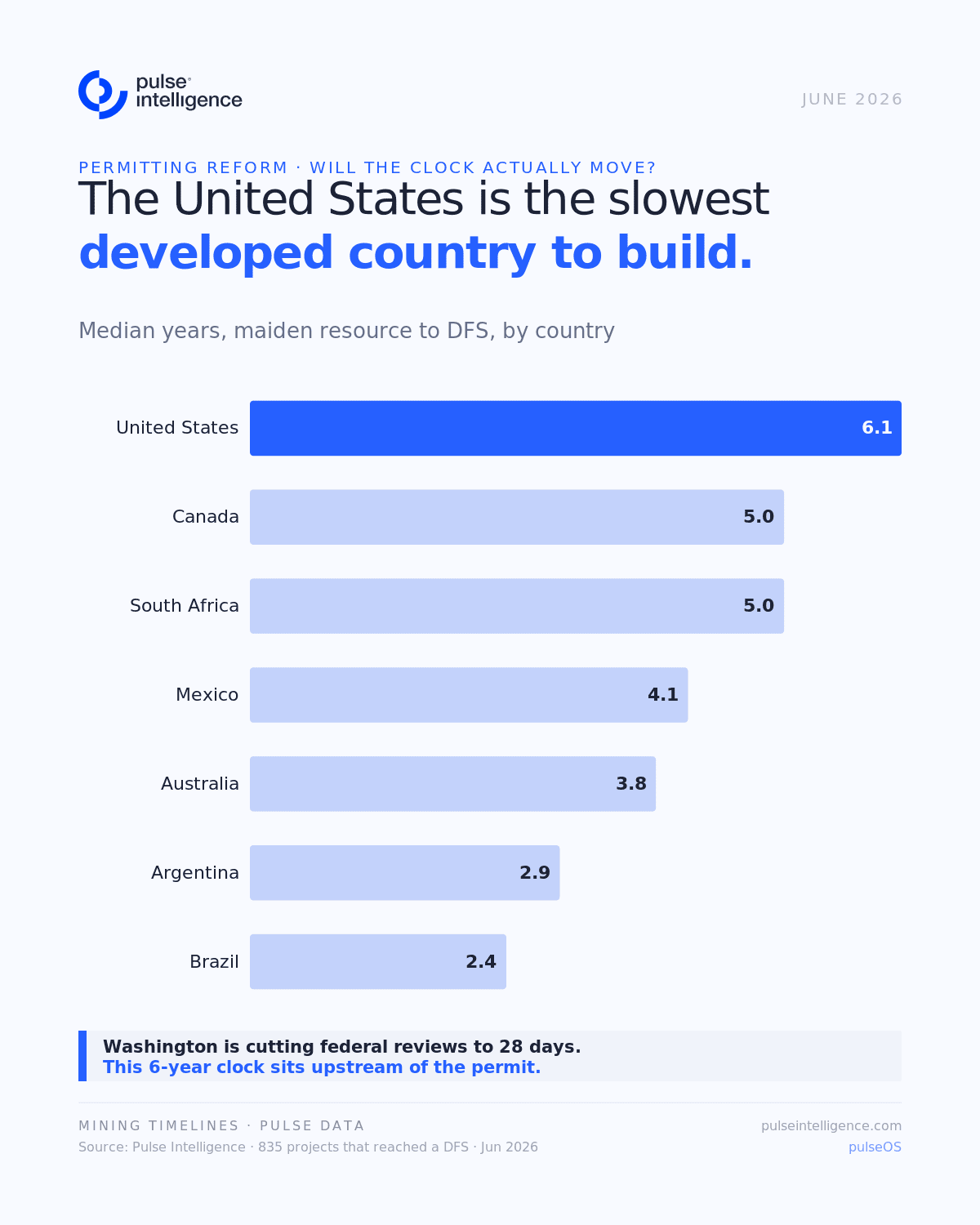
The United States is the slowest developed country to build
Pulse data across 835 projects that reached a definitive feasibility study tells a clear story on timelines by jurisdiction:
| Country | Median years (maiden resource → DFS) |
|---|---|
| Brazil | 2.4 |
| Argentina | 2.9 |
| Australia | 3.8 |
| Mexico | 4.1 |
| South Africa | 5.0 |
| Canada | 5.0 |
| United States | 6.1 |
The United States sits last. 6.1 years (median), from the moment a maiden resource is published to a completed feasibility study.
The 28-day clock doesn't start until year six
Here's what matters for anyone thinking about permitting reform: the federal environmental review is a late-stage process. It doesn't begin until after a project has a resource, has completed scoping, and has submitted an application.
That means the 28-day target (even if it's achieved) is operating on the last stretch of a six-year race.
The bottleneck isn't permitting. It's everything upstream:
- Drilling: enough holes to establish a resource, then infill to upgrade confidence
- Resource definition: maiden to indicated to measured, each stage requiring additional work
- Metallurgical testing: recoveries, processing routes, deleterious elements
- Engineering studies: PEA to PFS to DFS, each dependent on the last
None of those steps are touched by permitting reform. They're constrained by geology, capital, technical capacity, and time.
What the data actually tells policymakers
If the goal is to accelerate domestic critical minerals supply, permitting reform is necessary but not sufficient. The more impactful levers are upstream:
Exploration incentives: getting more drillholes in the ground sooner. The US has large critical mineral endowments; the constraint is the pace of delineation, not the existence of the resource.
Technical capacity: metallurgical labs, qualified persons, engineering firms. The pipeline of projects depends on the pipeline of qualified people to advance them.
Capital deployment: early-stage critical minerals projects in the US are under-funded relative to peers in Australia and Canada. Faster permitting doesn't solve a funding gap.
The 28-day target matters at the margin. But the 6-year clock starts long before the permit office opens.
Less searching. More strategising.™
Where does your team's data infrastructure sit today?
Answer 10 questions. Get a private diagnostic on your AI readiness, in minutes.
Less Searching. More Strategising.™
See the platform running on real mining data, and what it would look like for your team.