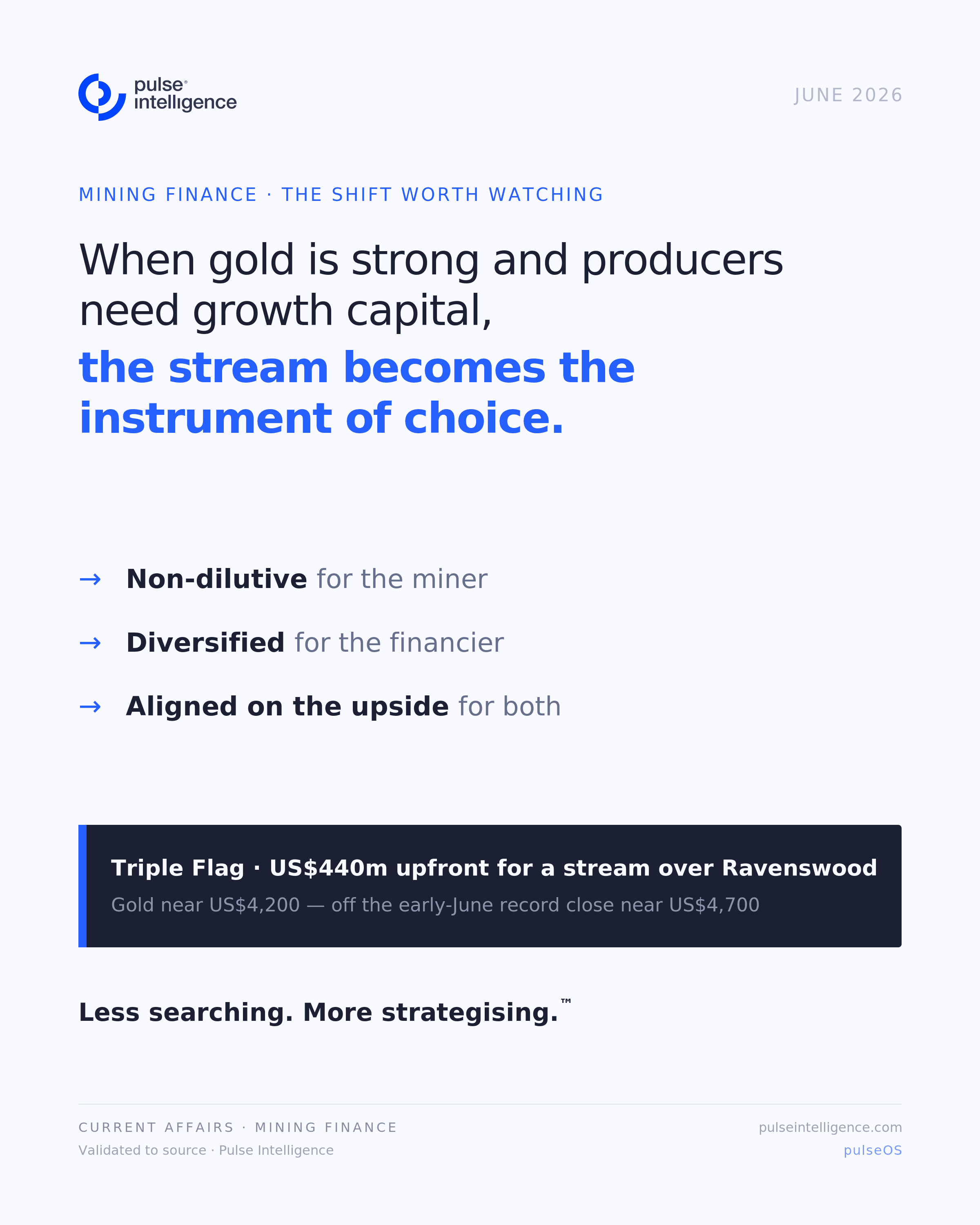
When gold is strong and producers need growth capital, the stream becomes the instrument of choice.
Triple Flag Precious Metals has committed US$440m upfront for a stream over Ravenswood Gold: a Queensland gold mine currently producing around 134,000 oz/yr, with a target of 200,000+ oz by 2028.
The deal closed near US$4,200/oz gold, off the early-June record close near US$4,700, but still at levels that make the economics of a stream compelling for both sides.
Why a stream, not equity or debt?
Three structural reasons this deal structure makes sense at current gold prices:
For the miner (Ravenswood Gold): A stream is non-dilutive. No new shares issued. No royalty payments that escalate with production surprises. The upfront cash funds the path to 200,000 oz, and the company retains full equity upside on everything above the stream threshold. At ~US$4,200/oz, Ravenswood keeps substantial margin on every ounce it sells above the streamed volume.
For the financier (Triple Flag): A stream provides diversified precious metals exposure without the operating risk of running a mine. Triple Flag locks in gold delivery at a predetermined rate, hedged against production variability. The US$440m upfront is effectively a long-duration, low-volatility gold position, with more structural protection than a bond and more upside than a royalty on net smelter returns.
For both: Alignment on the upside. The stream percentage is fixed; the gold price floats. If gold recovers to US$4,700 (or pushes higher), both parties benefit. That's rare in mining finance, where instrument structures usually create adversarial incentives.
The Queensland context
Ravenswood is one of Queensland's largest active gold operations. At 134,000 oz/yr, it's already a meaningful producer. The expansion to 200,000+ oz by 2028 requires capex the existing balance sheet couldn't absorb at this pace.
A US$440m stream solves that. It's not distress financing. It's growth capital structured for a high-gold-price environment, where the miner is confident enough in the asset to grant a stream, and the royalty company is confident enough to commit at scale.
What this signals for the sector
Streaming deal flow tends to accelerate when gold is strong. The miner gets more cash per ounce streamed (because the spot price is high), which makes the economics of granting a stream more tolerable. The streaming company gets a larger absolute return on the same percentage.
At near-record gold prices, the instrument becomes a consensus choice for producers with quality assets and expansion plans. The Ravenswood deal is a data point, but it's also a signal of where mining finance is heading.
Less searching. More strategising.™
Where does your team's data infrastructure sit today?
Answer 10 questions. Get a private diagnostic on your AI readiness, in minutes.
Less Searching. More Strategising.™
See the platform running on real mining data, and what it would look like for your team.