Picture an analyst at a mid-market PE fund with a mining mandate.
It is early 2026. Copper is trading at $13,731 per tonne. The structural case has never been stronger. The portfolio committee wants exposure. The analyst has three months to build a view on which assets, in which jurisdictions, at what stage of development, represent the most credible exposure to the 2030–2035 supply window.
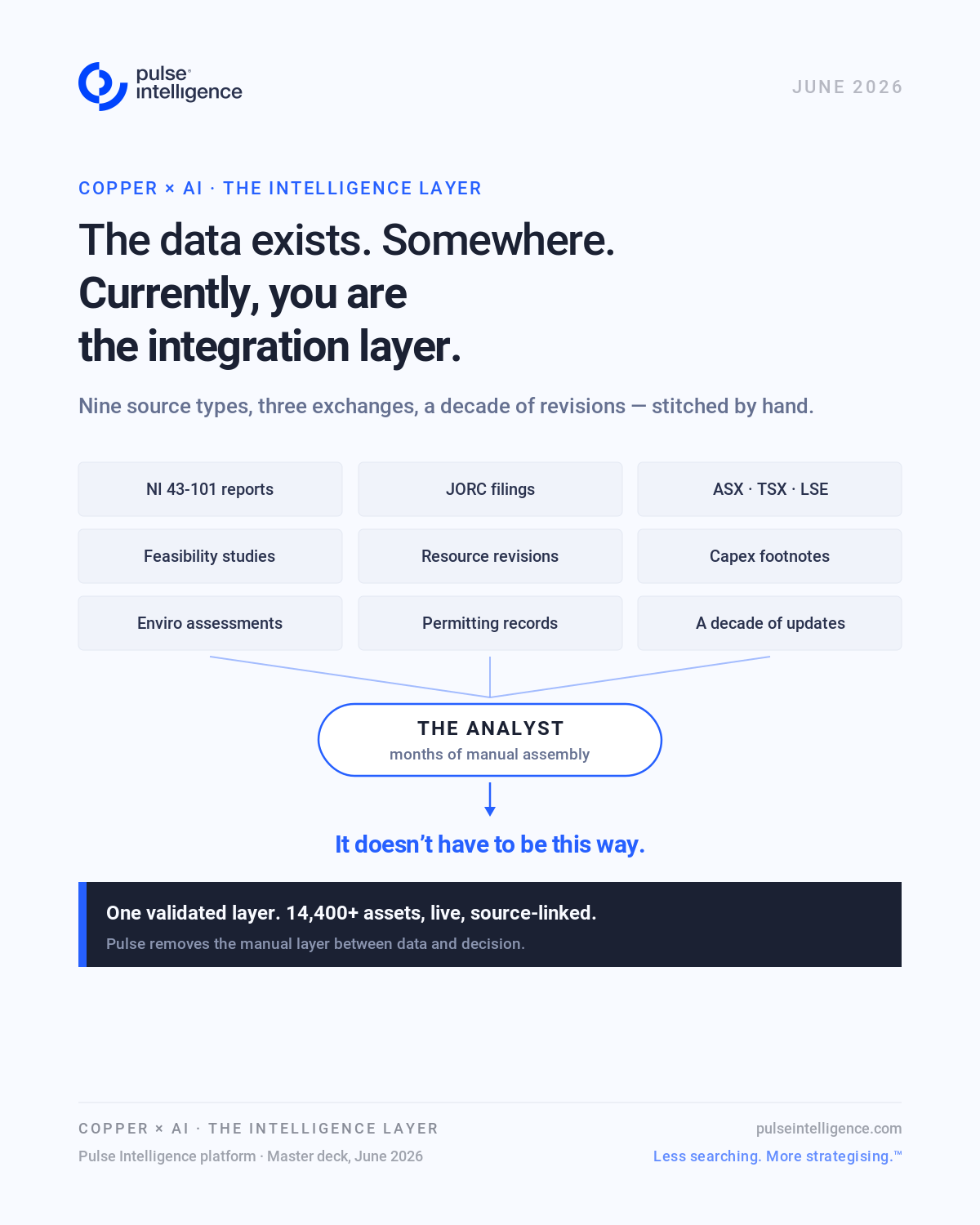
The data that analyst needs exists. Somewhere.
It is in NI 43-101 reports and JORC filings. In technical studies published across ASX, TSX, and LSE announcements over the past decade. In feasibility updates, resource estimate revisions, and capex disclosures buried in footnotes. Across dozens of assets, jurisdictions, and reporting standards that do not speak the same language.
Assembling it manually takes weeks. Validating data eats a third of your time. Some data is contradicted by more recent information the analyst has not yet found. Some of the grade estimates in the resource filings have been revised downward from the original study. Some of the projects have permitting challenges that only become visible when you read the environmental assessment, not the headline announcement.
And assembling it is only the screening pass.
Now imagine the committee asks the questions that decide the investment.
- Which of these projects has slipped a permitting milestone more than once, and in which jurisdictions is that a pattern?
- Has this management team built a mine before, and what did the last one cost shareholders in dilution?
- How has each feasibility study evolved across revisions: capex walking up, grade walking down, risk language quietly softening?
This is not a data scarcity problem per se. It is a data accessibility and validation problem.
And it matters more now than at any prior point in the copper cycle, because the decisions being made in the next 12 to 18 months will determine which capital is positioned for the supply window and which is not.
Our data across more advanced-stage copper assets globally puts the average time from first drill to first production at 18 years. From a completed feasibility study: 4 years. There are 50 copper projects currently in active feasibility globally and 62 in pre-feasibility. Almost none have FID approved.
The window for identifying which of those 112 projects are genuinely de-risked is not infinite. The projects that clear permitting, attract capital, and reach construction in the next two to three years will be the ones that matter. The rest will not close the gap.
The intelligence layer required to make those calls, at the speed and coverage the market now demands, is not a spreadsheet problem. It is a platform and process problem.
Pulse Intelligence solves this problem (and various others downwind from this workflow) with our agentic AI, now including chat.
Less searching. More strategising.™
Where does your team's data infrastructure sit today?
Answer 10 questions. Get a private diagnostic on your AI readiness, in minutes.
Less Searching. More Strategising.™
See the platform running on real mining data, and what it would look like for your team.