The most interesting deal from the critical minerals flurry was not the biggest. In fact, it was the smallest.
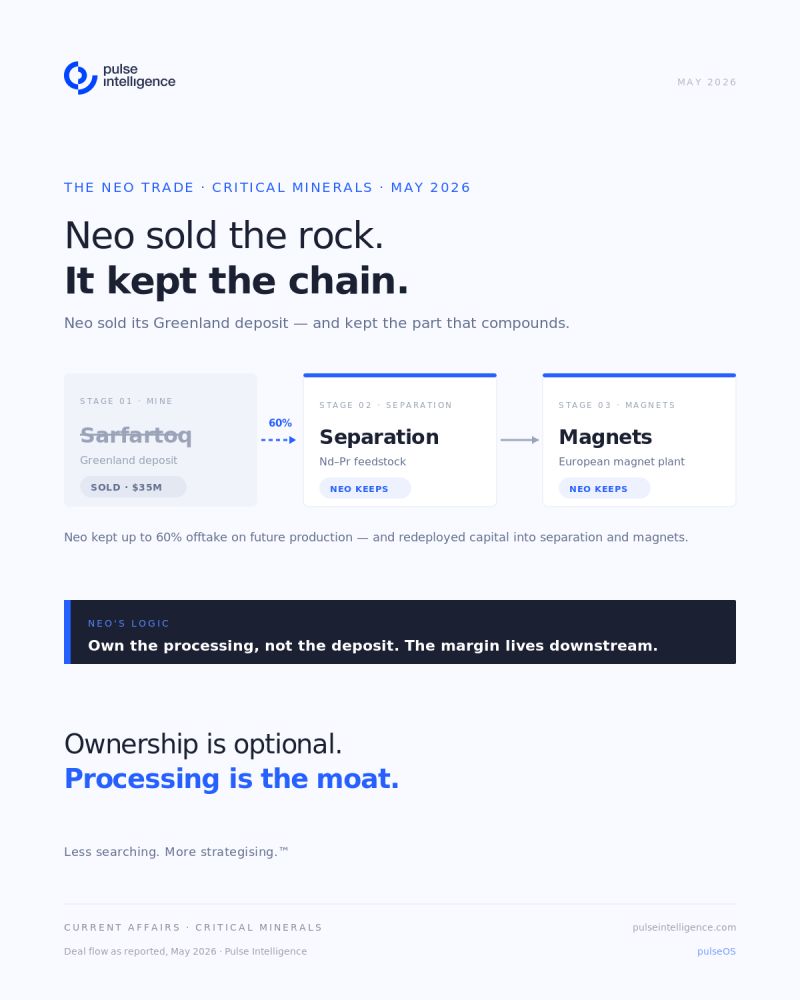
It was Neo Performance Materials selling its Sarfartoq rare earth project in Greenland to Greenland Mines Ltd for $35 million, while retaining offtake rights on up to 60% of future production.
Neo originally acquired Sarfartoq to secure upstream Nd-Pr feedstock for its European magnet business. Now it is divesting the asset, locking in the supply agreement, and refocusing entirely on downstream separation and magnet manufacturing in Estonia.
Neo is saying: we do not need to own the rock. We need to own the processing. And the same logic is playing out across the sector.
USA Rare Earth, Inc. (Nasdaq: USAR), which has already secured $1.6 billion in proposed US Department of Commerce funding and is pursuing a $2.8 billion acquisition of Brazil's Serra Verde, added another piece: up to $19.3 million in DOE funding for a pilot-scale rare earth separations project. Mine to magnet, vertically integrated, spanning the US, UK, France, and Brazil.
Perpetua Resources secured a $2.9 billion EXIM loan for its Stibnite project in Idaho, home to the only identified domestic antimony reserve in the United States. Defence-linked capital flowing directly into mine construction.
All three announcements landed on the same day.
What makes this moment different from prior cycles of Western hand-wringing is the specificity. These are not framework agreements or memoranda of understanding. They are transactions with dollar values, offtake terms, and construction timelines attached.
For investors and analysts tracking this space, the volume and velocity of deal flow in rare earths, antimony, and magnet metals is creating a screening challenge that manual workflows were never designed to handle.
The deals are here. The question is whether your intelligence infrastructure can keep up. Less searching. More strategising.™
Where does your team's data infrastructure sit today?
Answer 10 questions. Get a private diagnostic on your AI readiness, in minutes.
Less Searching. More Strategising.™
See the platform running on real mining data, and what it would look like for your team.