Gold settled at $4,070 an ounce yesterday. Most gold developers are still showing you what their project is worth at $2,400.
A handful have published the same study re-run at a higher gold price: same mine plan, same costs, same discount rate, only the gold price moves.
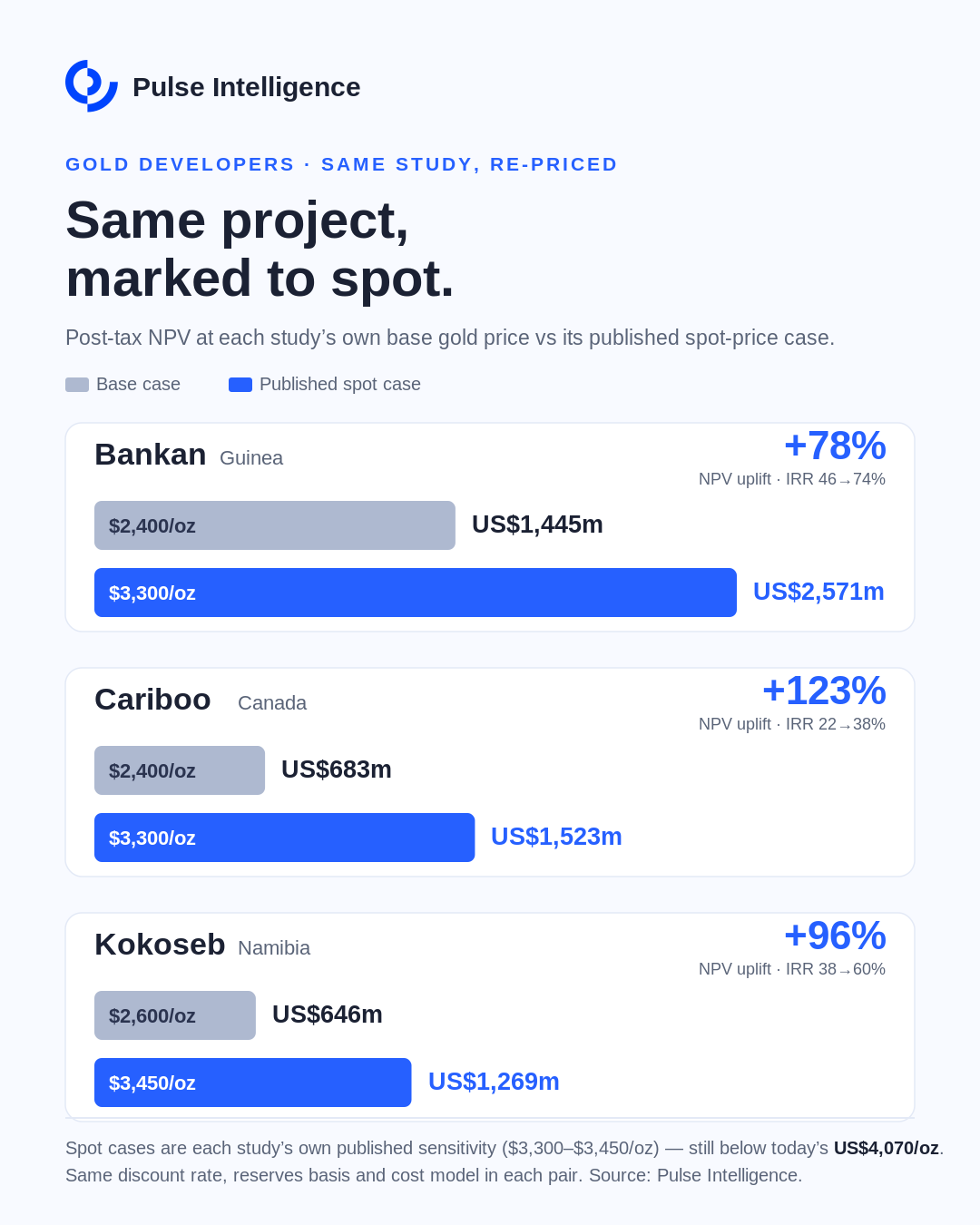
The gap is the part the market keeps skating past:
Bankan (Guinea): US$1,445m at $2,400 gold → US$2,571m at $3,300. +78%, IRR 46% to 74%.
Cariboo (Canada): US$683m → US$1,523m. +123%, IRR 22% to 38%.
Kokoseb (Namibia): US$646m → US$1,269m. +96%, IRR 38% to 60%.
And those "spot" cases still assume $3,300–$3,450. Gold is $4,070. So even these are the conservative versions.
Two things stand out.
Most developers haven't published a re-priced case at all. Hemi, Kiaka and Kiniero are still quoted on studies built at $2,100–$2,700 gold. The headline NPV in the deck is a real number; it's just answering a question about a world that has moved on.
And this is exactly why a comp is only a comp if the price deck underneath it lines up. A US$650m NPV struck at $2,600 gold and a US$650m NPV struck at $2,000 gold are not the same asset. You can't see that unless the assumption sits next to the number, and most screens don't show it.
So we put it there. Every economic study in Pulse carries the gold price it was written on, right next to the output. Makes it a lot harder to compare the wrong things.
Less searching. More strategising.™
Where does your team's data infrastructure sit today?
Answer 10 questions. Get a private diagnostic on your AI readiness, in minutes.
Less Searching. More Strategising.™
See the platform running on real mining data, and what it would look like for your team.