Contained metal is not recovered metal.
41%. That is the average nickel metallurgical recovery in Canada Nickel's Crawford feasibility study. The company discloses it in a footnote.
Canada's environment minister approved Crawford on 31 July, the first mining project to receive a Decision Statement under the amended Impact Assessment Act since 2019. The headline that travelled was the reserve: 3.80 million tonnes of contained nickel, second in the world only to Norilsk.
Contained is not recovered.
At 41% recovery, the 41-year mine plan ships 1.56 million tonnes of nickel. The other 2.24 million tonnes stay in the tailings.
NOTE: None of this is a criticism of Crawford. Low-grade ultramafic sulphide behaves this way; the recovery is disclosed in the study, and the mine plan was built around it. The problem is what happens when that asset needs to filter into a financial model for comps or benchmarking.
Almost every comparison table in the sector ranks development-stage projects on contained metal in reserve, because contained metal is the figure that sits in the resource statement and the figure a database picks up. Run that screen and Crawford prices at roughly US$71 per tonne of contained nickel against a US$269m market capitalisation.
Now run it on the metal the mine plan actually produces.
US$172 per tonne.
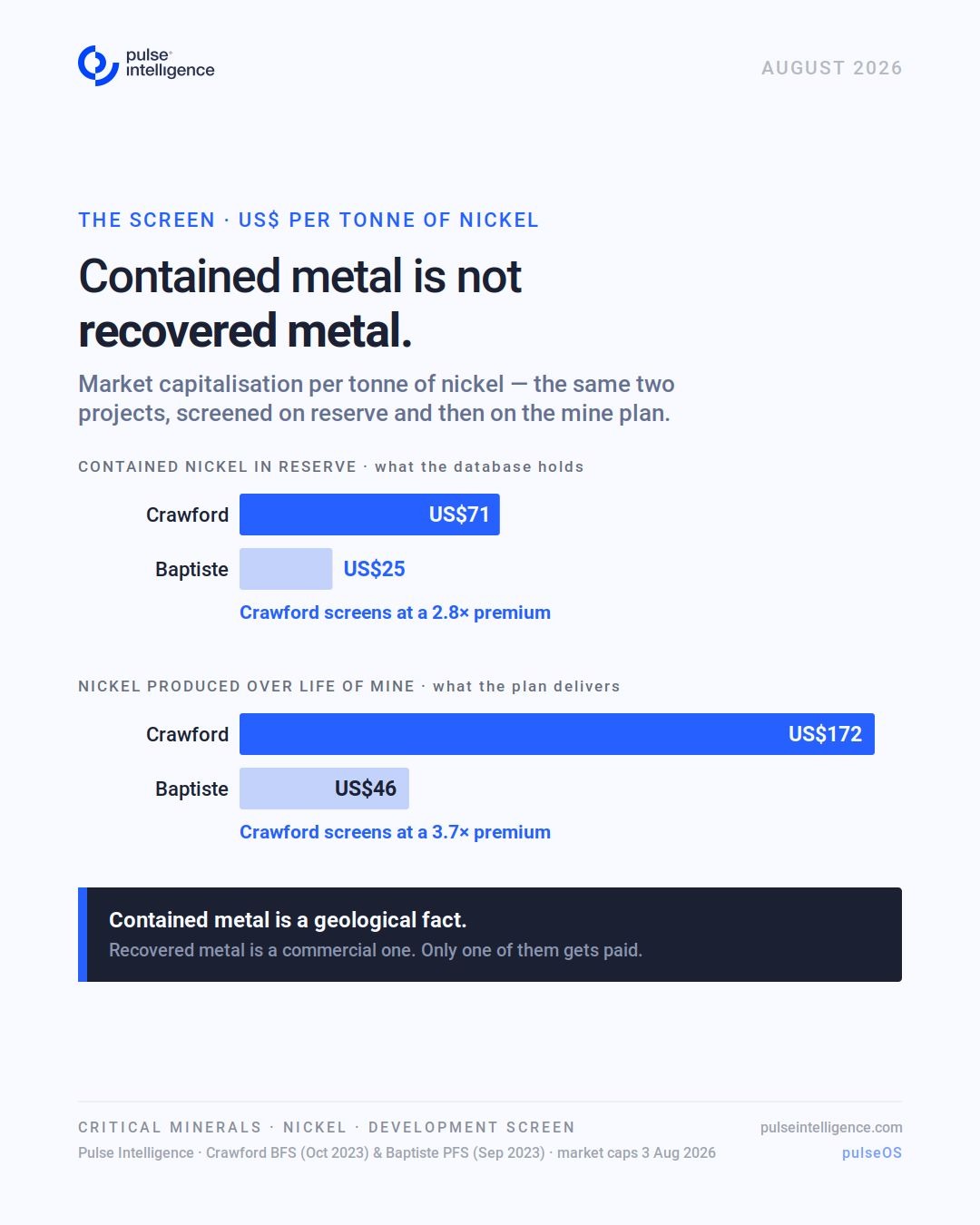
Apply the same test to FPX Nickel's Baptiste project in British Columbia. Its probable reserve holds 3,125kt of total nickel, but the mine plan is based on the magnetically recoverable awaruite fraction of 1,933kt, producing 59,100 tonnes a year over 29 years. On contained metal, Baptiste screens at US$25 per tonne. On produced metal, US$46.
The premium the market pays for Crawford is not 2.8 times. It is 3.7 times.
Two projects, near identical initial capital at US$2.05bn and US$2.18bn, and the smaller one delivers more nickel across a mine life twelve years shorter.
The point is not which is the better project. Reasonable people will disagree; the permit is worth something real, and Crawford's by-product credits carry it into the first cost quartile.
The point is that a screen built on whichever field the database happens to hold will rank assets in an order the metallurgy does not support. That error compounds every time a portfolio gets built from it.
Contained metal is a geological fact. Recovered metal is a commercial one. Only one gets paid.
Less searching. More strategising.™
Where does your team's data infrastructure sit today?
Answer 10 questions. Get a private diagnostic on your AI readiness, in minutes.
Less Searching. More Strategising.™
See the platform running on real mining data, and what it would look like for your team.