From scans to searchable intelligence.
You already own the data. You just can't use it, and it can't compound.
Decades of geological reports, drill logs and filings sit in scanned PDFs, images and handwritten archives, and a live flood of new disclosure lands every day. All of it digital. None of it usable by AI.
~5%
What basic OCR actually recovers from dense technical scans.
15+ hrs
Per analyst, per week, lost to finding data instead of using it.
Near enough
Isn't. Partial extraction means every cell gets re-checked by hand, the work you were trying to remove.
What a scanned archive cannot do
× Join the public record and government geoscience on the same ground
× Grow with every new disclosure, report and drill result
× Feed predictive work on how large a resource can become
Process the archive once. It compounds from then on.
Digitisation is the first return. On the Pulse layer your archive sits beside the public record and government geoscience on the same ground, and every new disclosure, report and drill result adds to it.
Day one
Your archive
Legacy scans, drill logs, maps and field notes, structured and linked to the page they came from.
Year one
+ Public disclosure
Filings, technical reports and drill results from 44 exchanges, added to the same ground as they land.
Year three
+ Government geoscience
State and federal survey records, open-file drill holes and your own new results and models, on the same layer.
↓
What the layer powers
Predictive geology
Resource potential modelled from every hole on and around the asset.
Standing screens and alerts
Your conditions, re-run as each new filing lands.
Cited answers in your own AI
Across your data and the public record at once, traced to the page.
Why scanned PDFs don't work for AI
To a machine, a scan is a photo. The information has to be rebuilt before AI can use it.
◆
Images of text
Blurry, skewed, multi-column scans where every word is just pixels, invisible to a model.
◆
Handwritten & stamped
Soviet-era logs, marginalia and degraded scans that off-the-shelf OCR can't touch.
◆
Maps & drill logs
Coordinates, sections and schematics carry the geology, and none of it is text.
◆
Crushed tables
Assay and resource tables collapse into noise; rows, columns and units are lost.
One automated pipeline, end to end
Documents land and the pipeline runs without manual intervention, from ingest to answer.
Ingest
Secure, encrypted pipeline with a dedicated environment per client: your data, your boundary.
OCR & extract
A hybrid stack of computer vision, OCR and model-based extraction. Bilingual output, with layout and tables preserved.
Structure & georeference
Typed schemas, unit standardisation and coordinate systems captured natively. Maps and sheets with no coordinates are placed as geometry.
Validate
Every figure scored against its source and cross-checked algorithmically by several methods, then signed off by a human. Extracted and scored, never inferred.
Talk to it
Query in plain language on the platform, or connect your own AI agent via the Pulse MCP.
Proven at scale, ground-truth validated on the hardest data
Ground-truth validated across all four assay report families of a major miner's Soviet-era Cyrillic corpus, scored against the client's own acceptance thresholds.
100M+
Pages digitised to date across disclosure, technical reports and government archives
Element-level
Every field checked against the source page, not sampled
Client thresholds
Scored against the client's own acceptance thresholds
4 report families
Assay extraction validated across every one
Source: Pulse Intelligence corpus and benchmark, anonymised · 2026
Your archive joins a record over 100 million pages deep
Pulse digitises the public and government record systematically, archive by archive, so the data under your models grows every day without a project of your own.
100M+
Pages digitised, across disclosure, technical reports and government archives.
83M+
Drill intercepts extracted and validated across the document corpus.
734,226
Government geoscience records across six Australian state and federal archives.
14,604
Canadian technical filings digitised, across 1,526 filers.
Government data
Disclosure
Source: Pulse Platform and document corpus, October 2026. Australian archive records counted by live endpoint test, August 2026.
See the geology, not just the text
The same structured corpus renders spatially, with 3D drill-hole visualisation live in production.
3D collars & intercepts
Surface-topography adjusted, so underground intercepts map correctly against terrain.
Every hole, reported or not
Holes without published assays sit alongside the reported results, so the full drilling picture reads at a glance.
Government tenements, integrated
Licence boundaries and ownership pulled live from official registries, draped over the same 3D terrain.
Time-slider & ArcGIS Pro
Watch holes appear over time and compare announcements, as a Pulse-served layer inside ArcGIS Pro.
The same corpus, rendered as intelligence
Once structured, the data surfaces across the Pulse front end: drill results, reserves and resources, and spatial views, every figure one click from its source document.
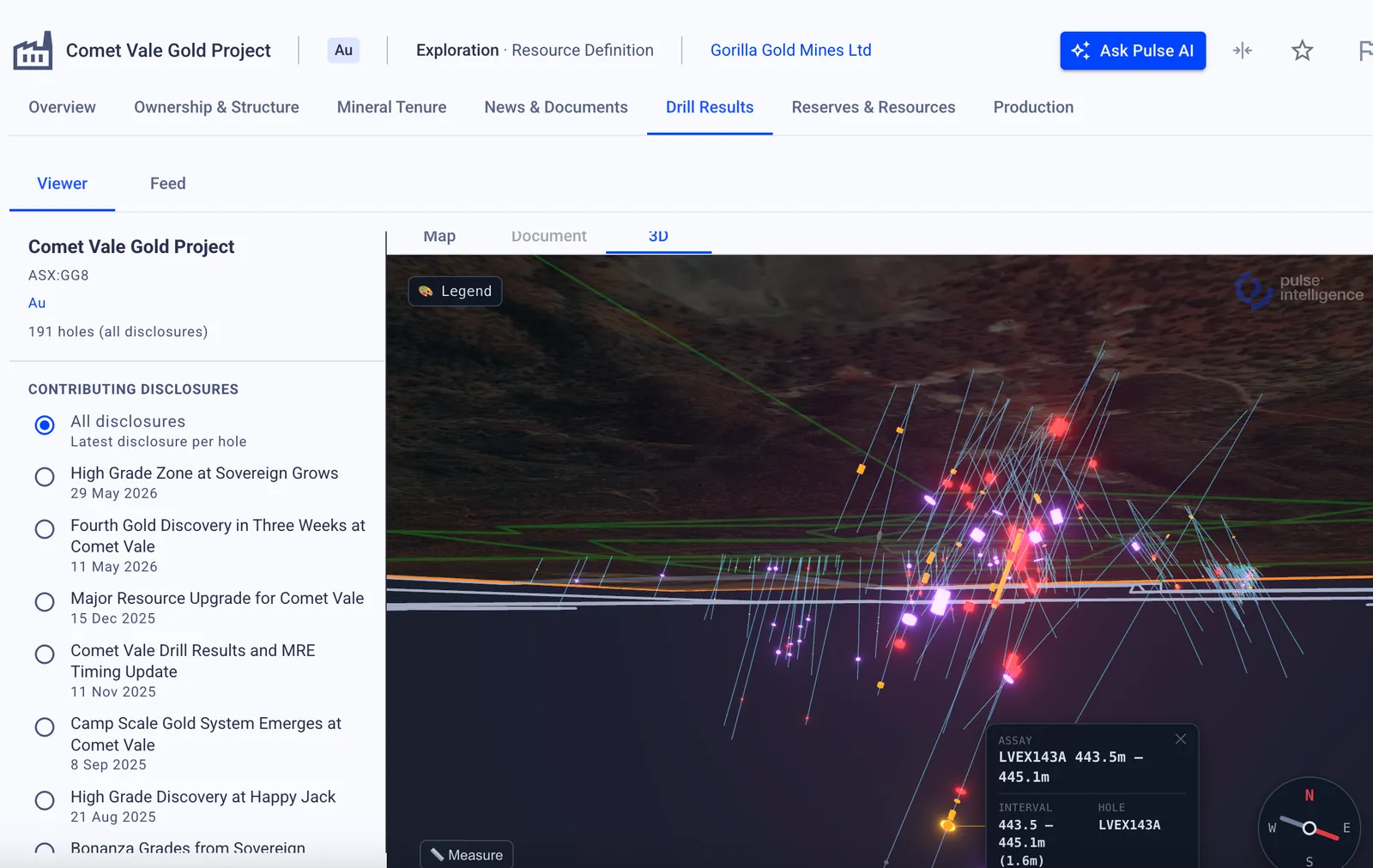
Drill results, coloured by grade. 637 holes across every disclosure, graded and source-linked.
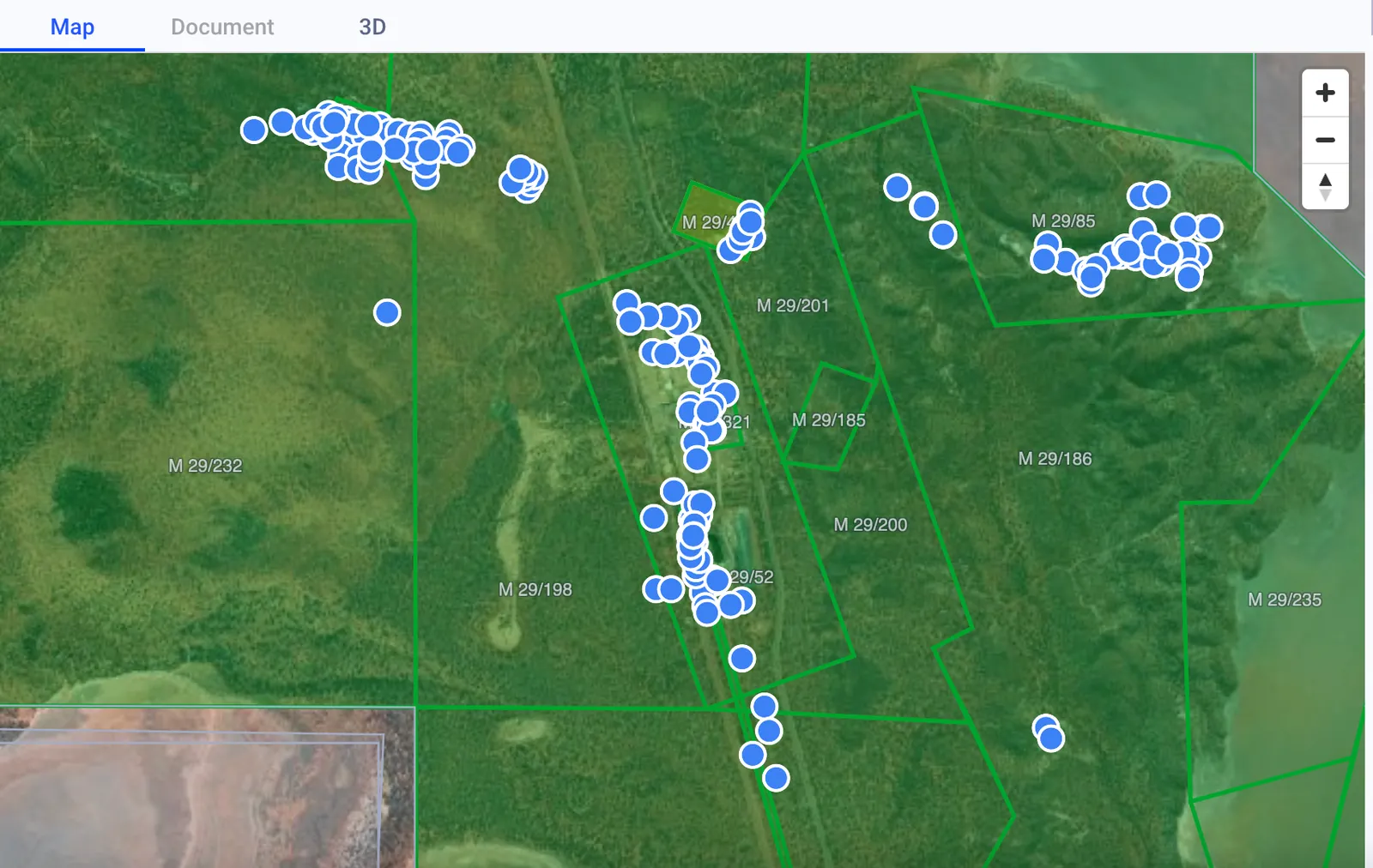
Collars on the map. Holes plotted on satellite imagery, georeferenced from the source archive.
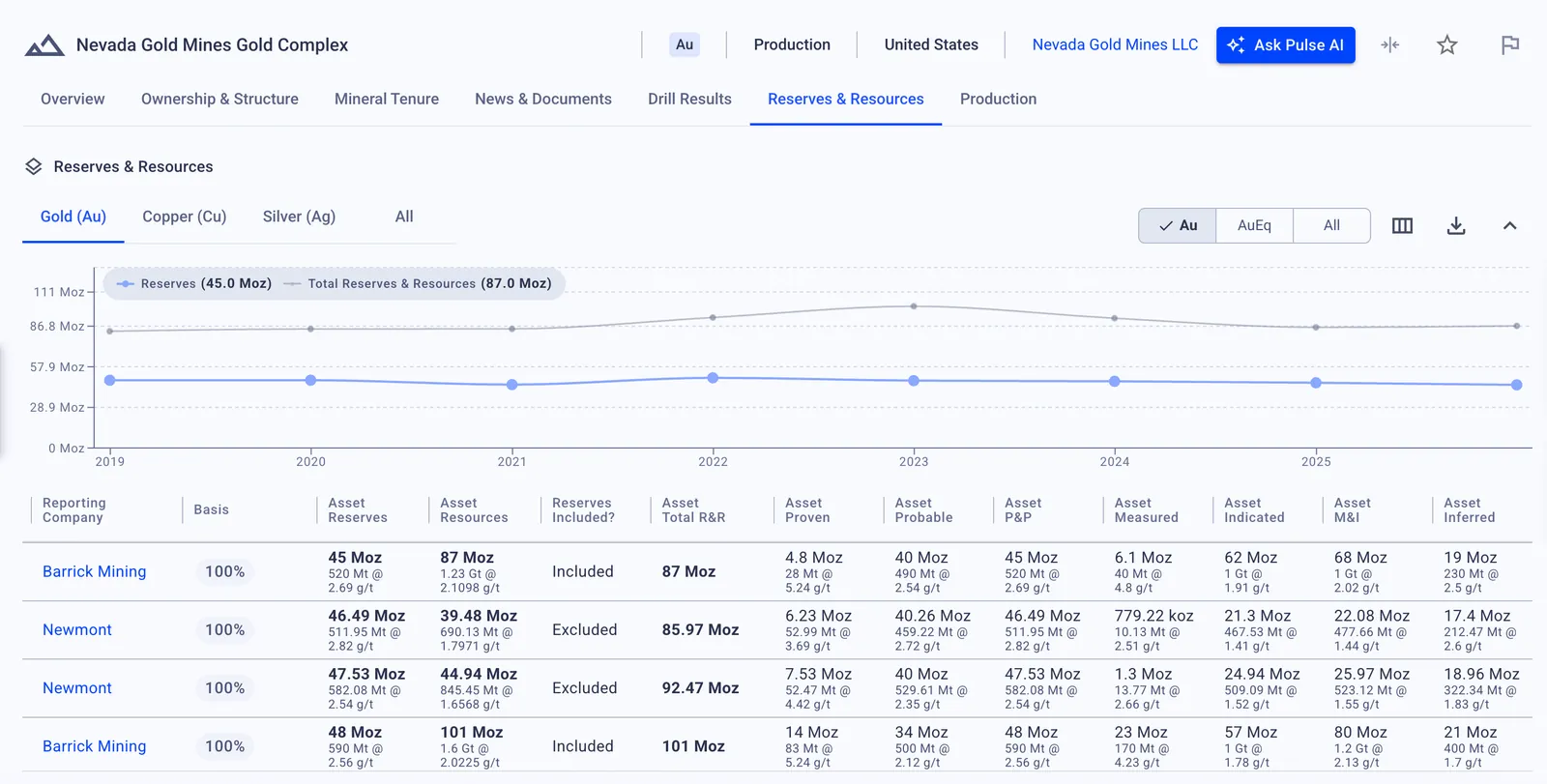
Reserves & resources, over time. Every estimate normalised, tracked across announcements, traceable to source.
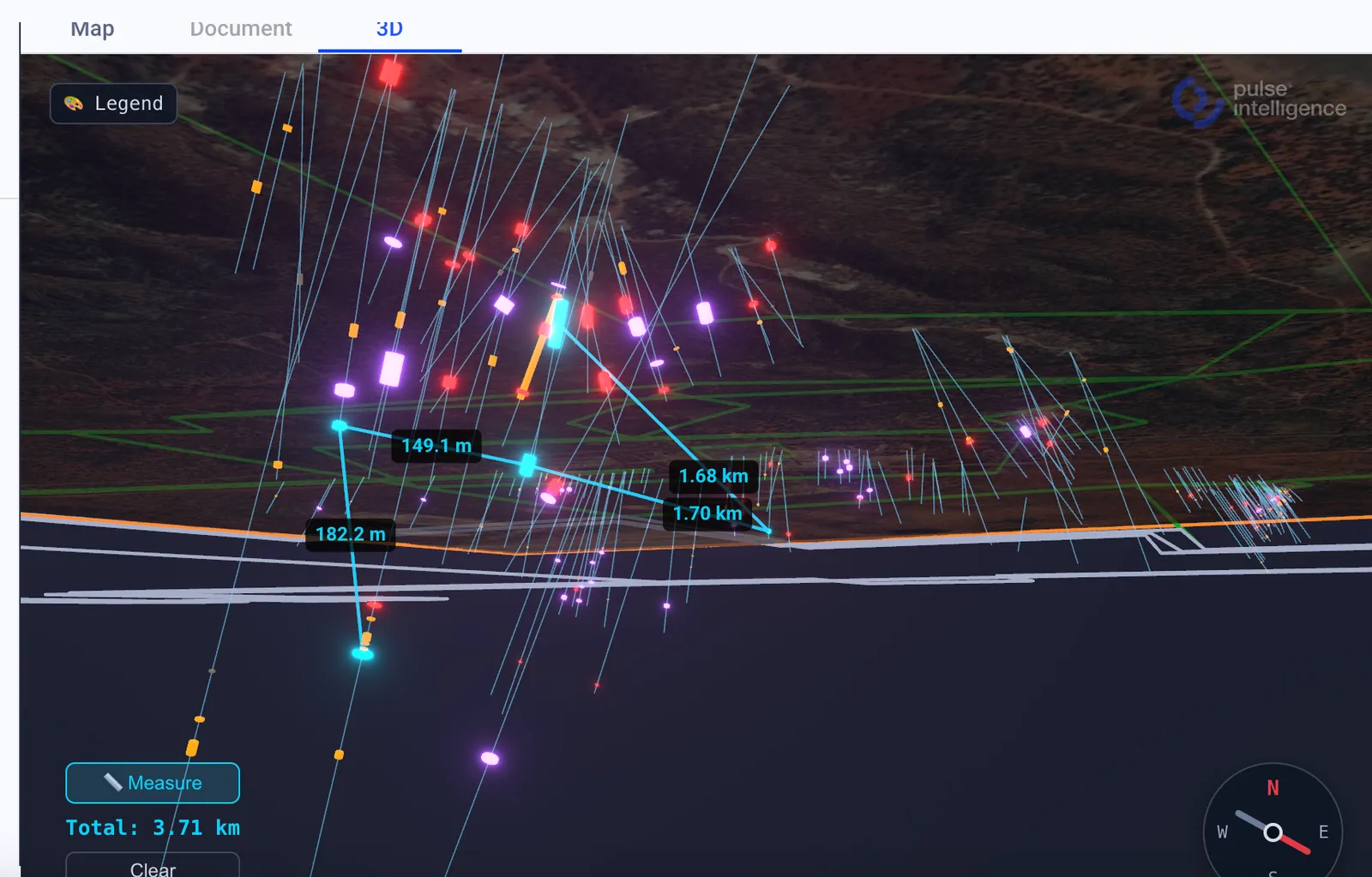
One project, every view. Exploration, tenements and production from a single structured corpus.
Illustrative views, publicly listed company · Pulse Intelligence platform
Ask a question. Get a cited answer.
Your whole corpus can be queried in plain language, in the platform or from your own AI via the Pulse MCP.
Plain-language questions
Ask across every translated document at once, with no query language and no digging through files.
Cited every time
Each answer links to the exact source document and page.
In the platform or the MCP
The same corpus inside Claude, ChatGPT or any agent you already use.
Ask Pulse
◉ Source: drill-result announcement · p.3 · assay table, validated
Illustrative: chat with your corpus in the platform or via the Pulse MCP.
The question that sets the price: how large can the resource become?
Once every historical hole, report and map is structured and placed, the resource potential of an asset is modelled from the record rather than from the owner's statement.
01
Translate
Full-corpus recognition with structure preserved, the original one click away.
02
Search
Keyword and semantic search, cited to the page and the table cell.
03
Extract
Decision metrics extracted, original and normalised values held together.
04
Ask the ground
Draw a polygon and ask in plain language. Collars, outlines and occurrences joined spatially, including sheets with no coordinates.
05
Visualise in GIS
A live service into ArcGIS Pro and QGIS.
06
Predict: how large can it become?
Every hole on the target and the ground around it, read against comparable systems to model resource potential before a price is agreed.
Each step holds only because the one beneath it is built. Live product: Comet Vale Gold Project, 359 holes.
Any language in. Any language out.
Ingested, translated and structured once, then queried and delivered in whatever language your reader needs. Ask in English against a Russian archive and read the answer in Spanish, from the same source-cited corpus.
→
Teams across regions
One corpus, read by every office in its own language, with no re-translation and no version drift.
Joint-venture partners
Partners on shared ground work from the same validated data, each in their own language.
Sovereign & government
National archives digitised in the local language, queryable by global investors in theirs.
Structured once, cheaper on every question after
Because the corpus is already extracted, structured to a mining ontology and validated, an AI queries it for a fraction of the cost of reasoning over raw documents.
50–300×
Fewer tokens per answer than an AI reasoning over raw documents.
Structured by ontology
Precise retrieval, with no scanning of 400-page PDFs at query time.
Validated up front
No re-checking or re-extraction when you ask; the work is already done.
The whole corpus
API-style conversations across all your validated data, not document by document.
Fewer calls per answer
A short query path of one or two calls rather than ten or twelve.
Source: Pulse internal benchmark comparing an AI over raw documents with the same AI over the Pulse MCP, June 2026.
Where your data lives, and how it reaches you
Digitisation is a one-time build. The data layer it produces keeps running: hosted by Pulse or inside your own environment, current every day, delivered into the tools your team already uses.
Your warehouse, or ours
Hosted on Pulse in a dedicated, encrypted environment, or delivered into your own warehouse and cloud. The full database is exported progressively from day one.
Delivered into your stack
Scheduled database drops, the Pulse API, read-only SQL, Excel and CSV, straight into your models, BI tools and pipelines.
GIS-native
Collars, downhole intervals, assays and tenement polygons as a live OGC service into ArcGIS Pro and QGIS.
Your own AI
The same validated layer inside Claude, ChatGPT or any MCP-capable agent, with every answer cited to the source page.
In-region and in-country
Data at rest in the EU, ingestion nodes in-region where an archive requires it, and in-country deployment for sovereign archives.
Kept current, without a project team
New documents flow in on a nightly delta, with late-arriving files re-checked, so the layer stays current for the life of the account.
Your data, your boundary
For a joint venture, a major or a sovereign archive, security comes first. These are the answers your IT and security teams will ask for.
Read-only, by enforcement
Query tools only, SELECT-only database roles, read-only transactions and no standing database credentials. Pulse cannot write to your systems.
Your environment, your region
A dedicated database and encryption boundary, optionally on your own cloud. Data at rest in the EU (Stockholm), with PDF OCR on Mistral in the EU.
Where inference runs
Over the MCP there is no Pulse inference at all: the reasoning happens inside your own Claude or ChatGPT, in your region. Embedded Pulse chat runs on the Anthropic API in the US.
Logging & retention
Tool calls log the query and its parameters; query results are never logged. Logs auto-purge after 90 days. Platform chat history is kept for the life of the account, and the window is negotiable.
Audit trail and human sign-off
Every figure links to its source page, and raw extraction is quarantined until your experts promote it. SOC 2 (including Processing Integrity) and ISO 27001 certification, with GDPR compliance, is underway, and a public trust centre is expected in Q1 2027.
Pilot, build and run, priced separately
Each engagement is staged so the output is proven on your own documents before the full volume is committed. You choose the scope, the deliverables and the pace.
1 · Pilot batch
A representative batch of your archive, processed and scored against ground truth before the full volume is committed.
2 · Build
The one-time engineering for your document families, priced as a fixed fee and delivered progressively from the start.
3 · Run
A published unit rate per page, per drill hole or per document, so new material is ingested at scale as it arrives.
The alternative: build it yourself
18–24 months, three to five specialist hires and roughly US$400k–600k, with no guarantee of a top-tier result.
Build-it-yourself figures modelled from comparable in-house programmes, anonymised · 2026
Hundreds of analyst-years, compressed into one layer
Modelled on a reference archive Pulse has processed end to end: a Soviet-era exploration corpus of roughly three million pages, against the same archive read, translated, extracted and checked by hand.
~280
analyst-years
To read and key the archive by hand, or about 28 years for a team of ten.
97%+
lower cost
About US$37.5m of analyst time, against a six-figure digitisation programme.
90%+
less time
Per technical report afterwards: eight to twelve hours of work reduced to under one.
Manual baseline: 3,000,000 pages at six pages an hour to read, translate, key and check, giving 500,000 hours; 1,800 hours per analyst-year at US$75 an hour for a bilingual geologist and translator. Report-time figure from Pulse client engagements, 2026. Reference archive anonymised.
Questions, answered
What does Pulse's data digitisation actually do?
Pulse converts static documents (scanned PDFs, images, maps, drill logs and handwritten archives, plus live disclosure) into structured, source-linked data you can query in plain language. Every figure is typed, normalised and cited back to its source page, and the result joins the public record and government geoscience on the same layer.
How accurate is the extraction?
Every extracted field is validated element by element against its source page (not sampled) on dense, ground-truthed assay data, including Cyrillic Soviet-era archives that basic OCR recovers almost nothing from. Each figure is cited back to the page it came from, so you can check any value yourself rather than take an accuracy claim on trust.
Can it read handwritten, stamped, or Cyrillic Soviet-era documents?
Yes. Pulse combines computer vision, OCR and LLM-based extraction with statistical reconciliation to handle handwritten, stamped and degraded scans, including Russian and Cyrillic archives, with bilingual output that preserves the original layout and tables.
How is this different from uploading documents to ChatGPT?
Pulse extracts and validates your archive once, into a private, encrypted knowledge base that knows mining terminology and units, so every answer is cited to a source page and every query is auditable. You can still use ChatGPT or Claude: connect it through the Pulse MCP and it reasons over validated data in your own environment, using 50–300× fewer tokens per answer than reading the raw documents.
What languages and formats can Pulse handle?
Pulse ingests PDFs, images, maps, spreadsheets and scans in Russian, Chinese, Spanish, French, Arabic and more. Each document is translated and structured once, then queried and delivered in whatever language the reader needs.
What can Pulse ingest beyond my own archive?
The same engine continuously ingests public-market disclosure (filings, technical reports, drill results) and regional and government datasets (geochemical surveys, open-file drill-hole databases, and tenement and relinquished-ground reports) onboarded jurisdiction by jurisdiction.
How does the cost compare to doing it ourselves?
Against reading the archive by hand, a three-million-page corpus is about 280 analyst-years and US$37.5m of analyst time; a Pulse programme is six figures, more than 97% lower. Against building a pipeline in-house, expect 18–24 months, three to five specialist hires and US$400,000–600,000 with no guarantee of the result. Pulse engagements are staged as a pilot batch, a fixed-fee build and a published per-page run rate.
Is my data secure and do I own it?
Yes. Each client runs in a dedicated, encrypted environment, hosted by Pulse in the EU or inside your own cloud, and the full database is exported to you progressively from day one. Access is read-only by enforcement, raw extraction is quarantined until your experts promote it, and SOC 2 and ISO 27001 certification, with GDPR compliance, is underway and expected in Q1 2027.
Talk to your archive.
Natural resources run on granular data. We automate that data and the decisions it powers. Bring us your hardest archive or your daily disclosure flow, and we'll show you what decision-ready looks like.
Less searching. More strategising.™
Where to go next
Who brings us an archive
Mining Companies & Sovereigns
The segment that names this as its constraint: decades of reports and maps they own and cannot query, plus sovereign and state-entity archives.
Senior Finance & Advisory
Consultancies and research houses with legacy archives of their own, and the peer tables they publish off them.
API & MCP
The same validated layer delivered by API, read-only SQL or the Pulse MCP, straight into your models and your own AI.
Get started
Ready to experience smarter insights?
Join us at Pulse Intelligence and transform your data experience. From real-time alerts to tailored financial and technical insights, we’re here to make data simplicity your new standard.
Fill in the form and will contact you to set up a call.