China's new mining controls take effect on 15 June. The regulations allow Beijing to restrict output, limit mining entities, and run security reviews on foreign investment in strategic minerals.
Which minerals? Not specified.
That ambiguity is not an oversight. It is the design.
By leaving the list undefined, Beijing retains maximum optionality. Any mineral, any time, any jurisdiction where Chinese capital touches a project. The uncertainty itself becomes the enforcement mechanism.
For investment banks running due diligence on mining targets, this changes the risk calculus overnight. For royalty and streaming companies tracking hundreds of assets, every project with Chinese ownership, offtake, or processing exposure now carries a new variable.
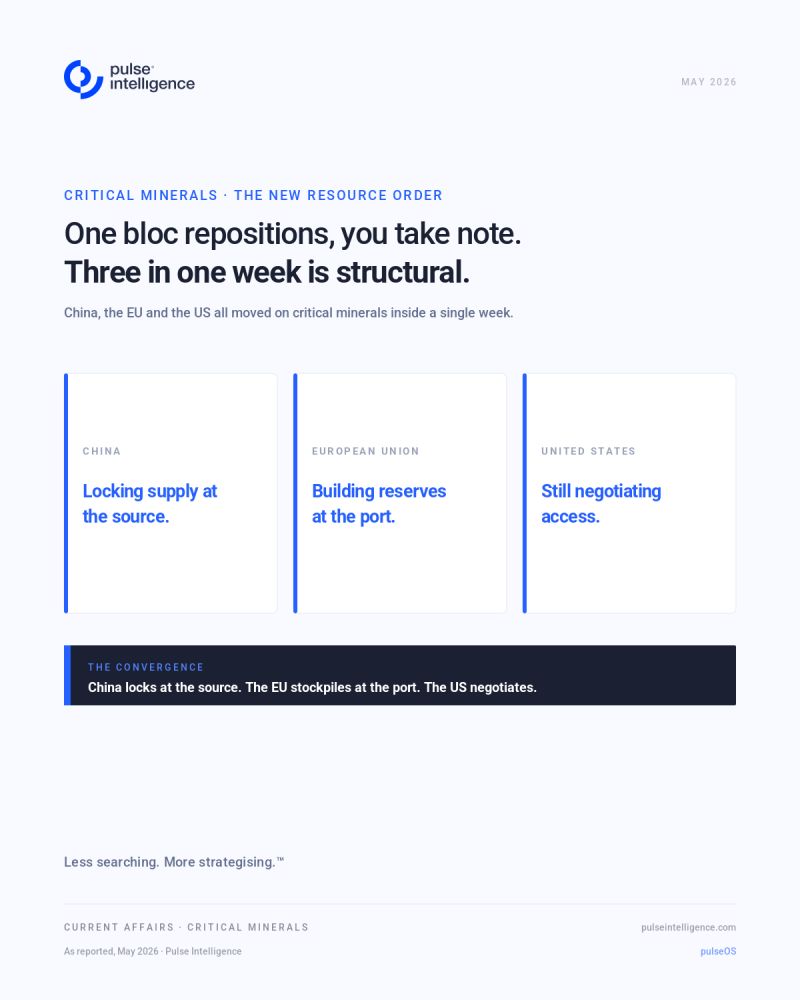
And the timing matters. This announcement came days after Trump left Beijing without a confirmed rare earths deal. The same day, the EU named tungsten, rare earths, and gallium for its first coordinated strategic stockpile.
The world's three largest economic blocs are now actively competing to control, stockpile, or secure access to the same set of minerals.
The firms that can screen their portfolios against these shifts in hours, not weeks, will have a material edge. The ones that cannot will be pricing risk with yesterday's data. Less searching. More strategising.™
Where does your team's data infrastructure sit today?
Answer 10 questions. Get a private diagnostic on your AI readiness, in minutes.
Less Searching. More Strategising.™
See the platform running on real mining data, and what it would look like for your team.