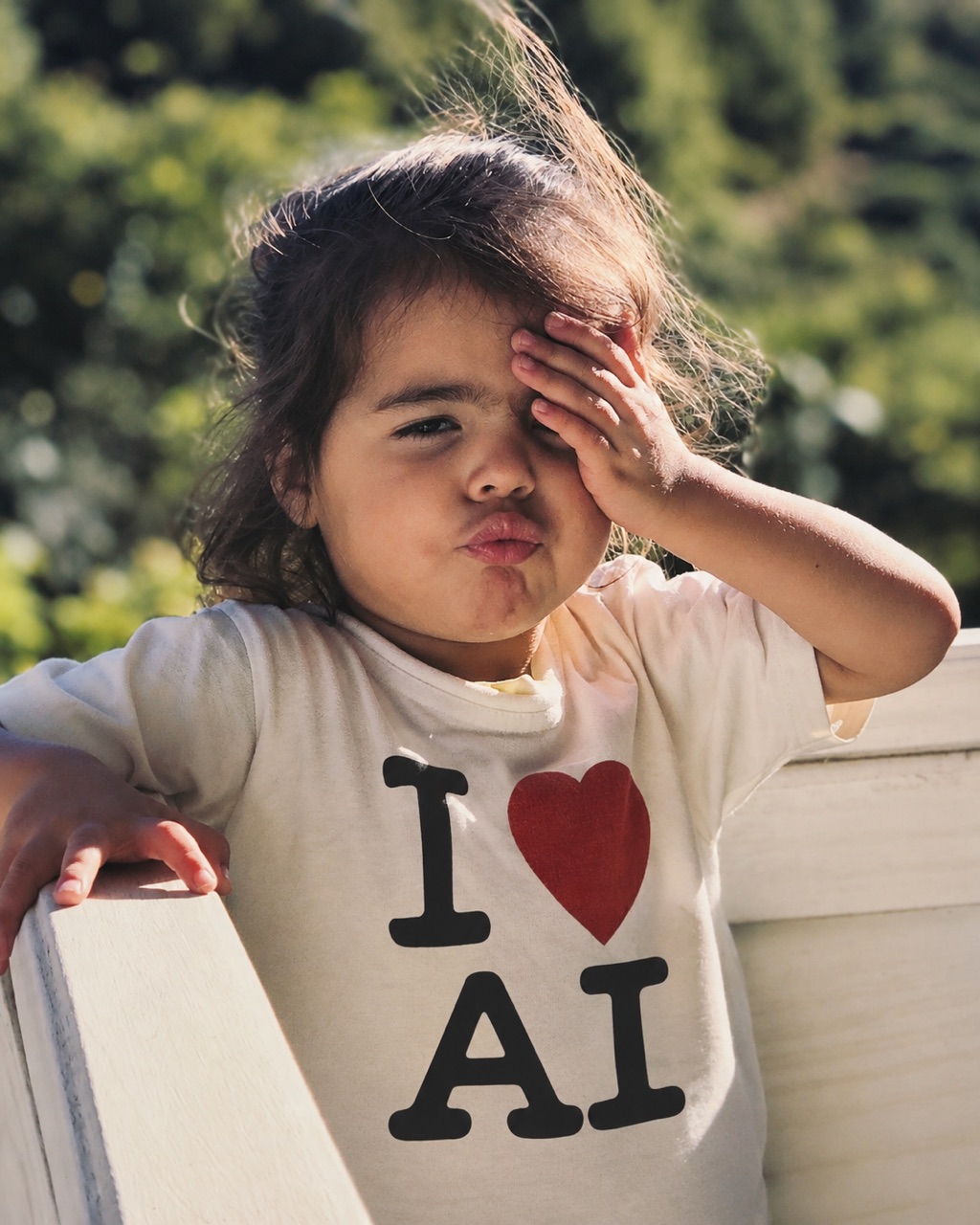
This is a real photo of my daughter when she was just under 2 (she's 10 now).
I changed the city on her shirt to "AI" for this post, which also happens to be my two kids' initials. Fate, perhaps.
I've always treasured this expression, as we can all relate to it! I couldn't think of a better image for today's post, sparked by two pieces I read yesterday.
The first is Sangeet Paul Choudary in Harvard Business Review. When companies bring in AI, the reassurance is "there will still be a human in the loop": the AI does the work, and people check its output.
Choudary calls that a trap. Every mistake a person corrects becomes training data, so the checking job shrinks every month, and you've put some of your best people in it. And AI sounds just as confident when it's wrong, so checkers start judging whether an answer reads well rather than whether it's correct.
His alternative: use AI to remove the work that held people back, then give them work that wasn't possible before. IKEA's largest retailer didn't keep call-centre staff checking its chatbot. It retrained 8,500 of them as remote interior designers and built a €1.3 billion sales channel.
The second is Richard Roberts's write-up from IMARC, where 11 Australian students and graduates discussed mining's future. Bella Durham, an environmental science graduate at a Queensland coal mine, expects AI to cut her time searching documents so she can spend more of it in the field. Matthew Zhang, a UWA geoscience graduate, says geological judgement remains essential. Mary Dark from Curtin: "Technology should modernise the culture not just the operations."
None of them want to spend their careers fact-checking a machine. They want the searching off their plate.
That depends on the data underneath. Our industry's information sits in long technical reports, under different reporting codes and ownership bases, with dates that are easy to miss. Point AI at that without structure and the answers come back fluent, confident and sometimes wrong. Then your best young geologist spends the week checking them.
Fix the foundation first: data traced to its source, normalised and dated. Then checking stops being the job.
This is also a talent question. The strongest graduates will go where the technology lets them do the work they trained for, and those companies will pull ahead. The ones still asking new geologists to dig through PDFs will find it harder to hire every year.
I'd like to believe that by the time my kids' generation chooses where to work, they'll expect this as standard. Truth is, it will be way sooner than that. I give it two years.
So, for anyone running a business: is your data good enough so that AI can do what it was designed for? Spoiler alert - "yes, it's in PDF and on a digital drive" does not count!
Less searching. More strategising.™
Where does your team's data infrastructure sit today?
Answer 10 questions. Get a private diagnostic on your AI readiness, in minutes.
Less Searching. More Strategising.™
See the platform running on real mining data, and what it would look like for your team.