"Agentic AI for mining" is a phrase that's easy to say and hard to earn. Plenty of tools now bolt a chatbot onto a pile of documents and call it AI. Mostly it isn't: not in any way you'd stake a decision on.
So here is what it actually takes, in plain language: what the system does, why the word "agentic" is the right one, and the unglamorous foundation the whole thing depends on.
The real business is data validation
Strip everything back, and the foundation is something deliberately unglamorous: data validation.
Public mining disclosure is a mess. Drill results, grades, reserves, production: scattered across decades of PDFs, in 60+ languages, every company reporting on its own basis, in its own units, to different standards. Anyone who has tried to build a clean comparison across even ten companies knows the real work isn't the analysis. It's trusting the inputs.
We spent two years building the layer that reads all of it. It pulls every number straight from the source document, normalises it to one standard, and cross-checks it across sources until there's a single figure you can trust, with a one-click trail back to the exact filing, page and date. We call that validated layer AuthentiQ™. 25 million pages indexed so far, with another 15 million about to come on for Western Australia alone. No model guessing. If we can't source it, we don't serve it.
That's the unglamorous part. It's also the whole point. Everything else sits on top of it, and it's what took two years, and a handful of tier-one royalty, streaming, investment banking, fund and advisory desks pushing on it every week, to get right.
Why "agentic" is the right word
Validated data is the prerequisite. It's also what lets the AI work properly, and cost-effectively, instead of hallucinating its way through 400-page reports.
The data is connected two ways.
Horizontally: every company, every asset, every commodity, globally, in one place.
Vertically: down the life of a mine (exploration, drilling, resource, development, permitting, production, M&A), stitched together, so a drill result links to the resource it feeds, the asset that holds it, the company that owns it, and the deal it eventually trades in.
That stitching is the hard bit, and it's what lets an agent do real work on its own. In practice, you can ask things like:
- "Every gold developer trading below its build cost in the Americas."
- "Rebuild this peer set on grade and all-in cost."
- "What changed across my portfolio's disclosures this week, and why it matters."
It runs the analysis across both axes, autonomously, and answers with the source attached. You choose which agents to switch on. You see exactly what each one touched. Nothing happens that you can't trace back to a filing.
Autonomy: it runs without you
Autonomy matters most when nobody's watching. The real shift is the work running while you're away from your desk, on a schedule, or triggered the moment a company files.
Configure an agent once: a portfolio brief every morning before you're in, a comp set refreshed when new disclosure lands, a standing watch on permit slippage. It arrives finished. Nobody presses a button.
And because the layer is exposed through MCP, those agents run inside the tools you already use (Claude, ChatGPT, your own models), and hand back finished artefacts, not a chat window. A live Excel comp model, rebuilt and re-sourced overnight. A board pack, regenerated on cadence. The output lands where your team already works.
A note on scope: this is mining-first
It's easy to mistake this for a corporate-finance tool, because deal teams take to it quickly. But the foundation is the rock: drill holes, grades, reserves.
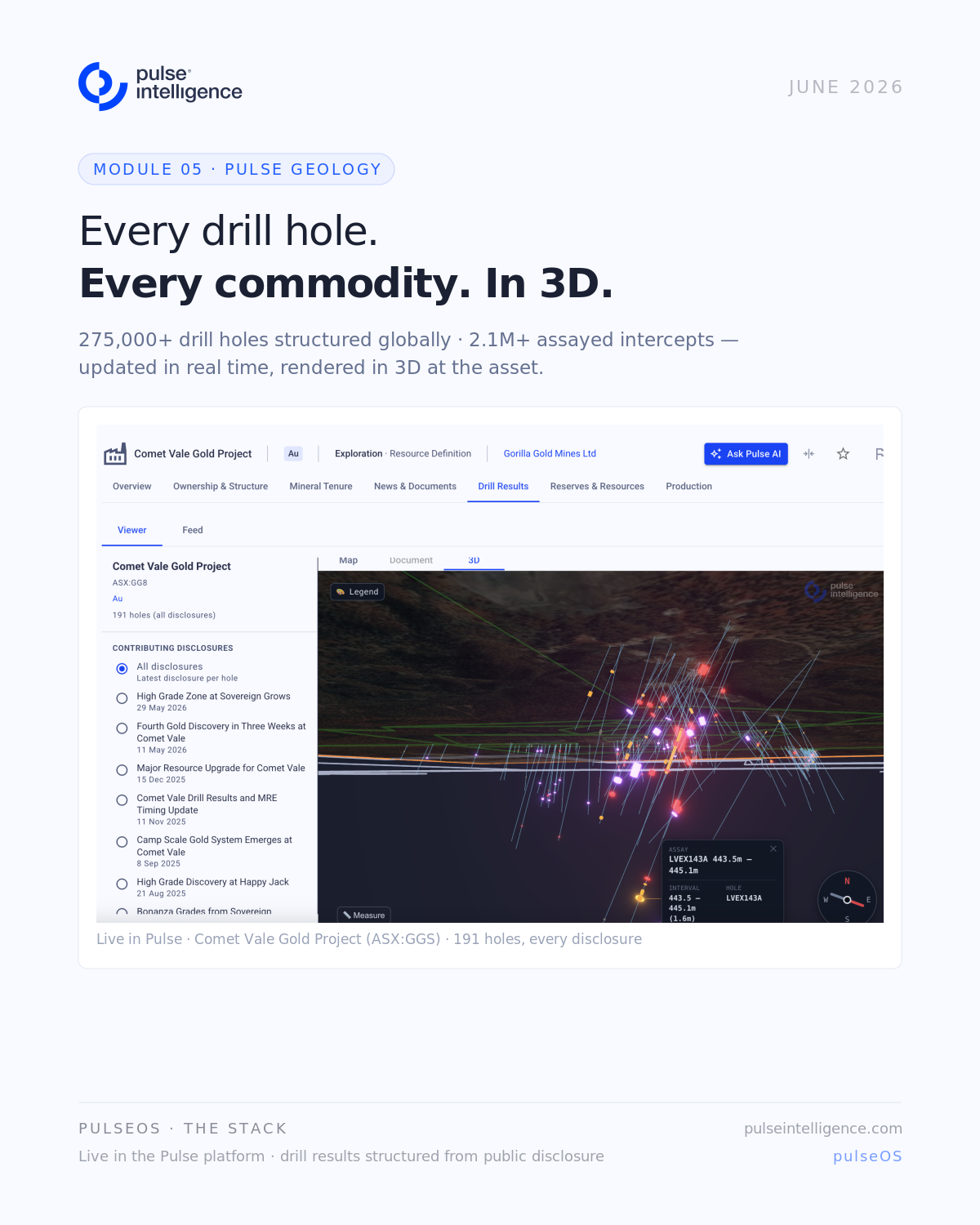
Corporate development is just one desk that runs on it. So do royalty and streaming teams, equity and hedge funds, technical teams, sovereigns and investors. The data is mining; the workflows on top are many.
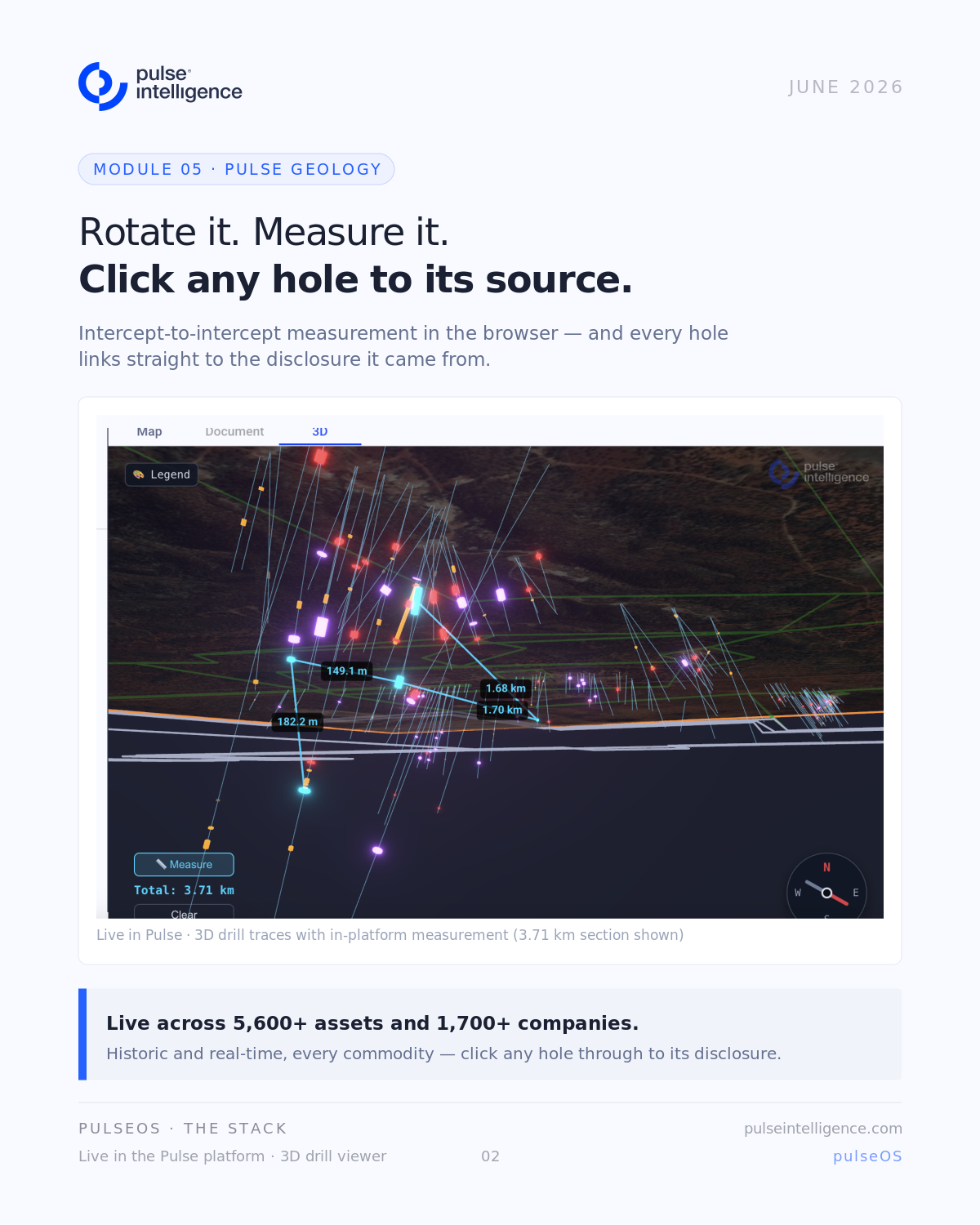
The depth you can't see in a screenshot
This is the part that's genuinely hard to show in a demo clip. The same validated layer is open via API and MCP, so it plugs into how you already work, not the other way round.
Around 70 connected tables. More than 450 structured fields, every one traceable to its source and updated dynamically with a full audit trail. Not a handful of headline metrics on a dashboard: 450-plus fields spanning company finance, production, reserves to international reporting standard, economic studies (NPV, IRR, capex), drill holes and intercepts, ownership and M&A. Behind it: 275,000+ drill holes and 2.1 million assayed intervals.
You can screen, compare and stress-test on almost any variable you can name, then pull the result straight into your own model, in minutes, not a quarter.
Ten modules, one layer, three ways to work
On top of that foundation sit ten modules. You don't buy all ten; you start with the one that hurts most, and switch on the rest as you grow.
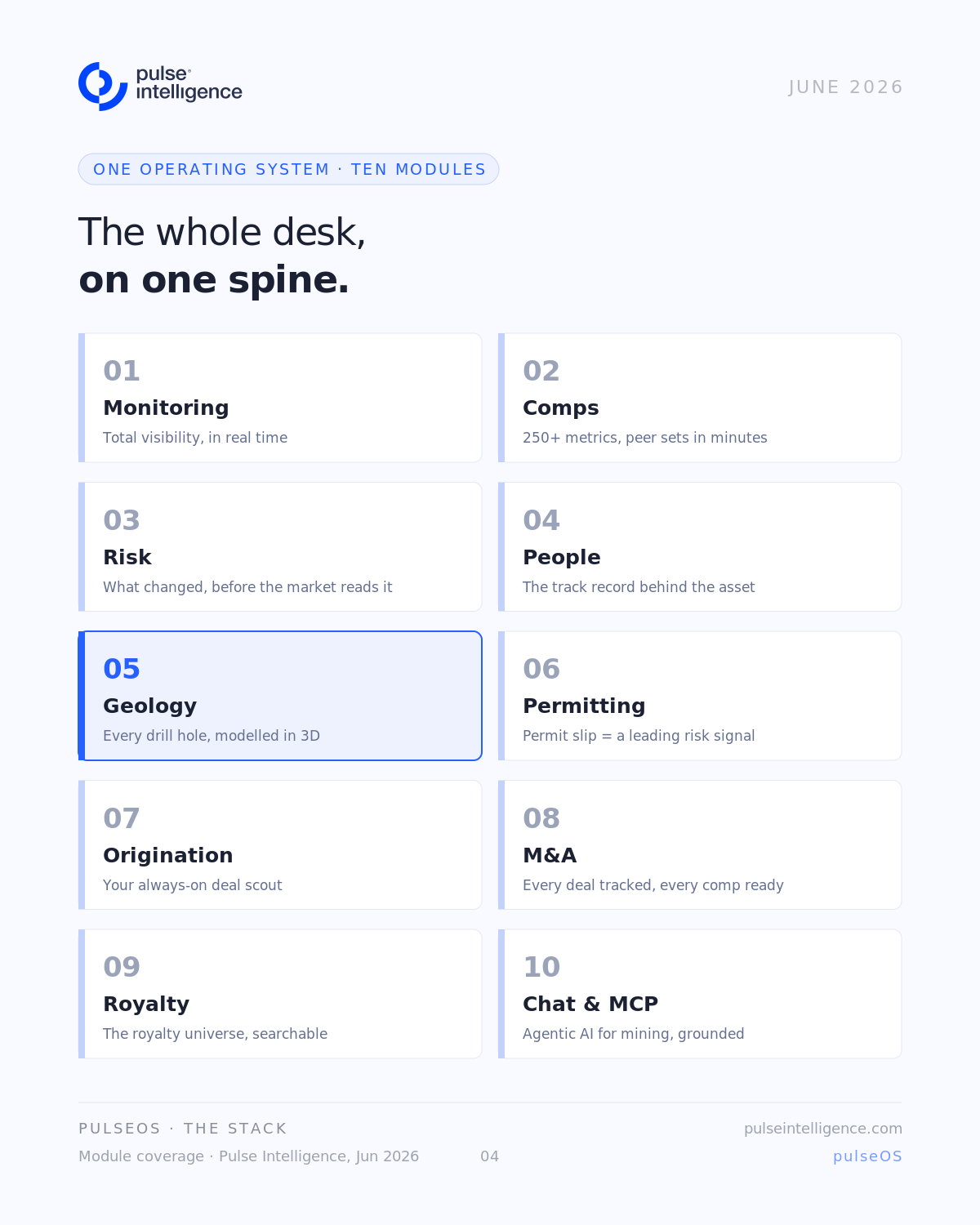
This month we shipped the piece that ties three of them together: the deal-flow spine.
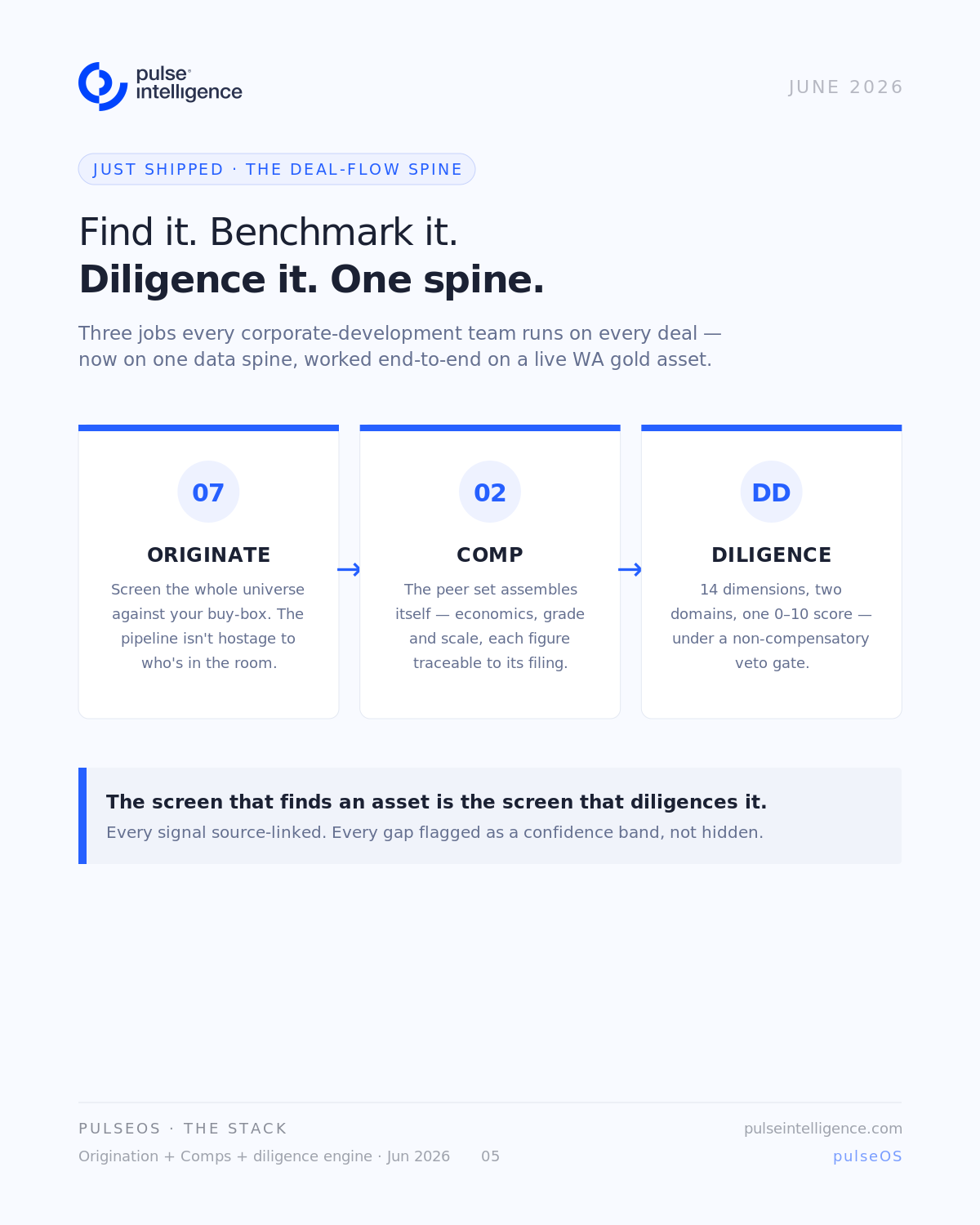
Origination finds the asset. Comps benchmarks it. The diligence engine pressure-tests it: 14 dimensions, one 0–10 score, under a veto gate. The screen that finds an asset is the screen that diligences it.
And you use it three ways: look it up (static, no AI required), ask it (agentic analysis), or let it run (automation). Same validated layer underneath all three.
See it for yourself
One honest caveat: don't trust marketing you can't understand. We wouldn't either.
So the least subtle test is the right one: see it. Fifteen minutes, you pick the asset, and you try to break it. If it's smoke, you'll know inside two.
Less searching. More strategising.™
Where does your team's data infrastructure sit today?
Answer 10 questions. Get a private diagnostic on your AI readiness, in minutes.
Less Searching. More Strategising.™
See the platform running on real mining data, and what it would look like for your team.