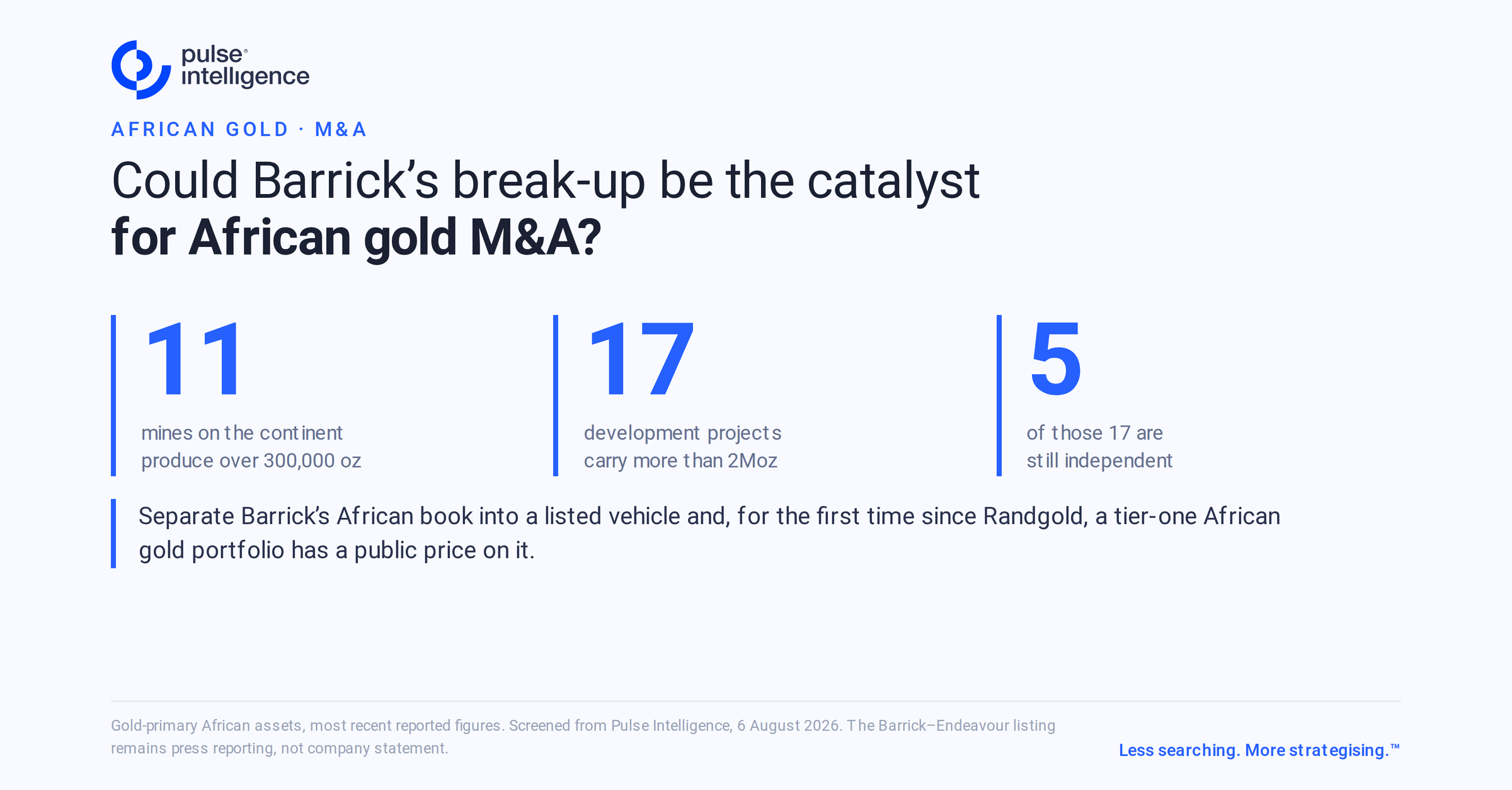
Eleven mines on the African continent produce more than 300,000 ounces of gold a year. Seventeen development projects carry more than 2Moz. Five of those seventeen are still independent.
That is the entire board. And Barrick is about to move the biggest piece on it.
Two splits are in motion. The North American IPO (Nevada, Pueblo Viejo, Fourmile) was authorised in February and is targeted for completion by year end. Then in June, Reuters reported Barrick was weighing a London listing for the African assets, possibly merged with Endeavour Mining. Around $30 billion combined. Neither party has confirmed it.
Most of the commentary has treated the African leg as a tidying-up exercise. Move the political risk somewhere it gets priced properly, let Toronto keep the clean stuff.
I think that badly understates it, and I want to argue the opposite case.
For twenty years, the best African gold assets have been locked inside diversified majors. Kibali sits inside Barrick. Geita and Sukari sit inside AngloGold. Tarkwa and South Deep sit inside Gold Fields. Assets held that way don't trade. They get managed, capital-allocated against Nevada or Cadia or Boddington, and occasionally sold in ones and twos when a portfolio review demands it.
Separate Barrick's African book into a listed vehicle and something changes structurally. For the first time since Randgold, there is a large, liquid, Africa-focused gold producer with a public price on it: one that can issue paper, be bid for, and act.
That is the unlock. Everything interesting follows from it.
Scenario one: the consolidator finally exists
Endeavour is already the closest thing West Africa has to a natural buyer. $12.5 billion market cap, $1.26 billion of cash, 16.6 million ounces of reserve, 1.21 million ounces produced last year at $1,433 an ounce. What it has lacked is scale sufficient to move on anything transformational.
Bolt Barrick's African assets onto that and you get a producer well north of two million ounces, LSE-listed, with Africa as the whole story rather than a segment in an appendix. A company like that doesn't buy juniors opportunistically. It buys them systematically, because growth is the only reason its shareholders own it.
Which matters, because of how little there is.
Screen the continent for gold-primary mines producing over 300,000 ounces: eleven. Screen for development projects carrying over 2Moz of resource: seventeen. Strip out the ones already inside Sibanye, Harmony, Pan African, Montage, Endeavour, Allied, Shandong, Baiyin and Chengtun, and the genuinely independent pool comes down to roughly five names: Bankan, Doropo, Kokoseb, Kobada, Bilboes.
Five. That is not a reason to expect nothing to happen. It's a reason to expect whoever moves first to set the price for everyone after them, and for the second mover to pay a premium they'd rather not have paid.
Scenario two: Zijin comes back, differently
Chinese capital is already deeply into African gold. Zijin Gold International owns Akyem outright. Shandong holds 85% of Namdini and is building Twin Hills. Chifeng holds 90% of Wassa, Zhaojin 90% of Abujar, Baiyin a cluster across the DRC and South Africa, Chengtun the Ngayu belt.
But the ceiling on that strategy just became visible. Zijin's C$5.5 billion takeover of Allied Gold cleared Investment Canada Act approval, cleared ECOWAS and COMESA on competition, was voted through by 99.54% of Allied's shareholders, and had the Ethiopian government lobbying Beijing in its favour. It terminated on 29 July anyway, having never obtained Chinese approval. Zijin took 9.2% of Allied for $295 million instead.
Read that as a defeat if you like. I read it as a frustrated buyer with an unresolved appetite, now holding a strategic stake and a demonstrated willingness to deploy capital without control.
If takeovers of that size can't clear, the money doesn't go home. It goes into minority positions, streams, offtakes and project finance. That's a quieter form of consolidation and a much harder one for a Western competitor to outbid, because there's no premium to pay and no shareholder vote to win.
So the question I'd put to anyone modelling this: what does Barrick's African vehicle do when Zijin turns up on its register rather than across the table from it?
Scenario three: everybody else has to answer
AngloGold, Gold Fields and Harmony have spent a decade being told African exposure is a discount, not a franchise. If a separately listed Africa pure-play re-rates (and the whole logic of the split is that it should), that argument inverts overnight.
At which point the pressure isn't on Barrick. It's on every major carrying African ounces inside a diversified structure to explain why they still are.
That is how consolidation cycles usually start. Not with a big deal, but with one company proving a valuation thesis that makes everyone else's structure look indefensible.
What I'd want to know on Monday
Barrick's exploration and evaluation spend was $247 million in 2025, guided up to $320–350 million for 2026. The company doesn't split that by region in its filings, so I can't tell you what lands in Africa.
I'd like to, because it settles the most important question in this whole argument. If Barrick's African vehicle is going to be a consolidator, it needs a pipeline. If it's going to be consolidated, it doesn't.
The five independent projects on the continent get bought once. After that, the only way anyone grows in African gold is by finding something. Whichever entity comes out of this split with a serious exploration budget is telling you which of those two futures it thinks it's in.
Kurmuk starts up this month. It should do 240,000–270,000 ounces in its first full year in 2027, which would make it the twelfth name on that list of eleven. It exists because somebody drilled it out, not because somebody bought it.
That's the part of this story I'd be watching, and it's the part nobody is writing about.
Less searching. More strategising.™
Screened from Pulse Intelligence at 6 August 2026: gold-primary assets in production, most recent reported annual figure; development-stage screen at 2Moz total resource inventory. Transaction and approval details from company releases; the Barrick–Endeavour listing remains press reporting, not company statement.
Where does your team's data infrastructure sit today?
Answer 10 questions. Get a private diagnostic on your AI readiness, in minutes.
Less Searching. More Strategising.™
See the platform running on real mining data, and what it would look like for your team.